
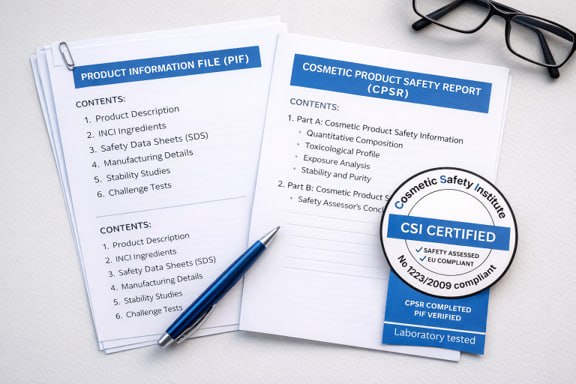
Anyone wanting to launch a cosmetic product on the European market will sooner or later encounter a key requirement: the Cosmetic Product Safety Report (CPSR). For many founders, start-ups, and cosmetic manufacturers, this term initially evokes uncertainty. Is a CPSR really necessary? What data is required? And what happens if a product is sold without a safety assessment?
In fact, the CPSR is one of the most important documents for the legally compliant marketing of cosmetic products within the European Union. A cosmetic product may not be placed on the market without a proper safety assessment.
What is a CPSR?
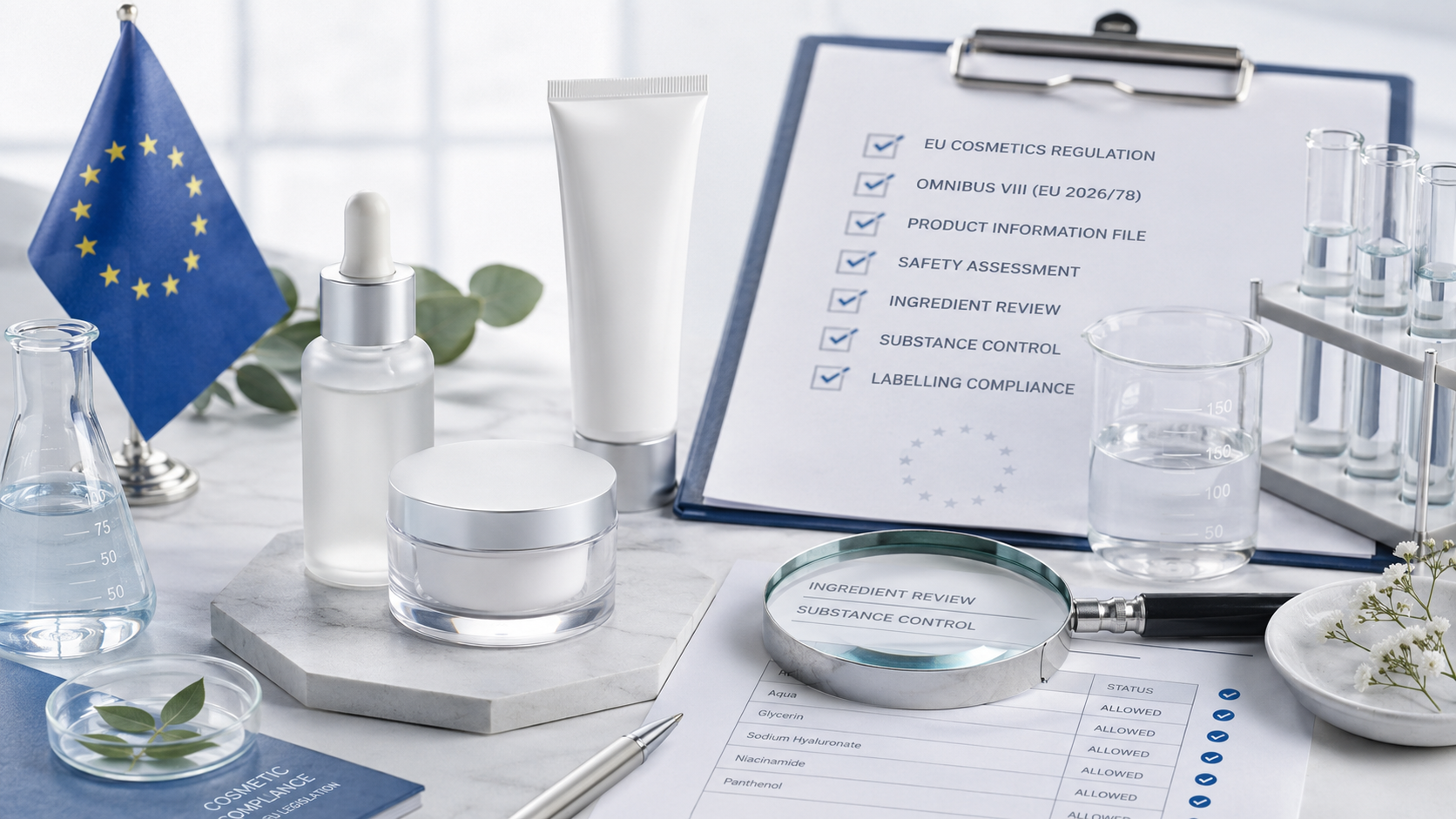
The Cosmetic Product Safety Report (CPSR) is the legally required safety assessment of a cosmetic product in accordance with the EU Cosmetics Regulation (EC) No. 1223/2009.
The goal of the CPSR is clear: it must be demonstrated that a cosmetic product is safe for consumers under normal or foreseeable use.
This includes an assessment of the ingredients, the concentrations of the individual components, possible toxicological risks, and the intended use of the product.
The CPSR simultaneously forms an essential part of the Product Information File (PIF) and is a prerequisite for subsequent CPNP notification.
In short:
No CPSR = no legally compliant marketing within the EU.
Who needs a CPSR?
A common misconception is that only large cosmetics companies need a CPSR.
In fact, this obligation applies to almost all cosmetic products that are to be sold within the European Union.
These include, for example:
- skincare products
- Creams and lotions
- Serums
- Shampoos
- Hair care products
- Perfumes
- Deodorants
- Make-up products
- Lip care products
- Beard care products
Once a product falls under the definition of a cosmetic product, a safety assessment is usually required.
We frequently assist companies that are building their first private label and are surprised by how extensive the regulatory requirements are even before the actual sales launch.
What data is needed for a CPSR?
The quality of a security assessment depends directly on the information provided.
The most important documents include:
- Full recipe
- Raw material specifications
- Safety data sheets for the raw materials
- Microbiological specifications
- Stability data
- Packaging information
- Product description
- Planned application of the product
Depending on the product type, additional data may be required.
A common mistake is assuming that a formula alone is sufficient for creating a CPSR. In practice, important raw material information or test reports are often missing, which can delay the entire process.
How much does a CPSR cost?
The cost of a CPSR depends on various factors.
This includes in particular:
- Complexity of the formulation
- Number of ingredients
- Availability of raw material data
- Number of product variants
- Necessary additional tests
Products with well-documented raw materials can generally be evaluated much more efficiently than formulations with rare or poorly documented ingredients.
Companies should be aware that a low-priced CPSR is not automatically the best choice. The professional quality of the safety assessment and the regulatory experience of the safety assessor are crucial.
How long does the creation process take?
The processing time depends primarily on whether all required documents are complete.
If all the necessary documents are available, the production can usually be completed within a few working days to a few weeks.
Missing raw material data, incomplete documentation, or necessary laboratory tests often significantly lengthen the process.
For this reason, it is advisable to consider regulatory requirements during product development and not just shortly before the planned sales launch.
The most common mistakes in CPSR creation
In our daily practice, we repeatedly encounter similar challenges.
The most common mistakes include:
Incomplete raw material documentation
Many manufacturers do not receive all safety-relevant information from their suppliers.
Missing stability evidence
A product must remain safe and stable throughout its entire shelf life.
Incorrect product classification
Not every product is automatically classified as a cosmetic under regulations.
Insufficient documentation
Missing data often leads to queries, delays, and additional costs.
Regulatory planning too late
Many companies only start addressing regulatory requirements shortly before entering the market.
What happens without CPSR?
The consequences of a missing CPSR are often underestimated.
A cosmetic product may not be made available on the European market without a safety assessment.
Possible consequences include:
- Distribution bans
- Complaints by authorities
- Product recalls
- Warnings
- Reputational damage
- Liability risks
Such measures can have significant economic consequences, especially for young brands.
Why a professional security assessment is crucial
A CPSR is far more than a regulatory obligation. It forms the basis for the safe and legally compliant marketing of a cosmetic product.
A high-quality safety assessment not only creates legal certainty, but also reduces risks for manufacturers, retailers and consumers.
The Cosmetic Safety Institute supports companies with all regulatory requirements relating to cosmetic products. From product safety assessment (CPSR) and product information file (PIF) creation to CPNP notification, we guide manufacturers, start-ups, and brand owners on their path to a successful market launch.
Our work is based on regulatory expertise, sound specialist knowledge, and practical experience from numerous cosmetic projects. This allows us to identify potential risks early and design regulatory processes efficiently.
Conclusion
The Cosmetic Product Safety Report is not an optional formality, but a legal requirement for the marketing of cosmetic products within the European Union.
Those who rely on a professional security assessment early on avoid delays, reduce risks and create the basis for a successful product launch.
Do you want to check whether your product requires a CPSR or what documentation is needed for the safety assessment? The Cosmetic Safety Institute team will be happy to assist you with the next regulatory steps.
CPSR, Cosmetic Product Safety Report, CPSR costs, cosmetic safety assessment, CPSR cosmetics, EU Cosmetics Regulation, have a CPSR prepared