
You develop innovative cosmetic products — we take care of regulatory safety, compliance, and all requirements for a successful EU market entry.
Assessment of whether the product qualifies as a cosmetic product and is market-ready.
Formula development; formulation and regulatory review of all raw materials.
Ensuring manufacturing in compliance with ISO 22716.

Demonstration of stability, quality, and product safety.
Review of labeling, mandatory information, and claims.
Preparation of the safety assessment prior to market entry in accordance with EU Regulation 1223/2009.

Preparation of the complete Product Information File in accordance with EU Regulation 1223/2009.
Notification in the EU portal prior to market launch.
Start of serial production after approval.

Ongoing assurance of compliance and quality.
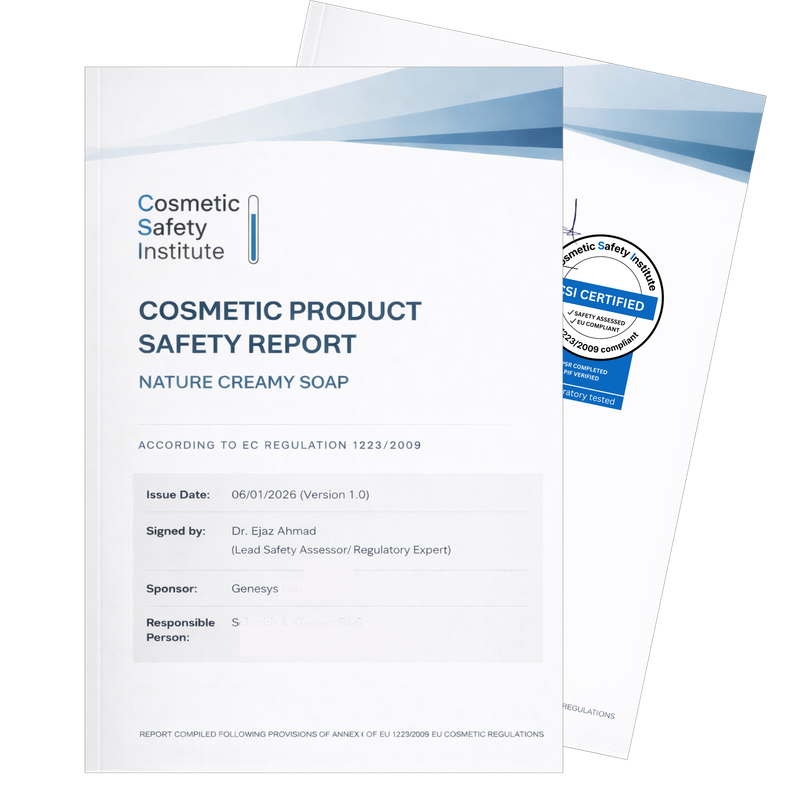
We will prepare the complete product safety assessment (CPSR) for your cosmetic product in accordance with Article 10 in conjunction with Annex I of Regulation (EC) No 1223/2009.
The CPSR is the central legal safety documentation for cosmetic products prior to being placed on the market in the European Union.
The Cosmetic Product Safety Report (CPSR) confirms that your cosmetic product is safe for human health under normal and reasonably foreseeable conditions of use.
The CPSR is not a voluntary test, but a legal requirement for selling your cosmetic product in the EU.
According to Article 10 of Regulation (EC) No 1223/2009, the responsible person must have a safety assessment carried out in accordance with Annex I before the product is placed on the market for the first time. This assessment is a mandatory component of the Product Information File (PIF) pursuant to Article 11.
Without a signed CPSR, the required proof of product safety according to Article 3 is lacking. Your product cannot then be fully documented in accordance with regulations, properly notified, and legally placed on the EU market.
In short: Without CPSR, there is no legal marketing of your cosmetic product.
You will receive a signed safety assessment (CPSR Part A & Part B) in accordance with Article 10 in conjunction with Annex I of Regulation (EC) No 1223/2009 as part of your PIF in accordance with Article 11.
The CPSR provides the regulatory basis for CPNP notification under Article 13 and the lawful placing of your cosmetic product on the market in the EU.
This provides you with the legally required safety certification to prepare your product for market compliance. Without this safety assessment, your cosmetic product cannot be legally marketed.

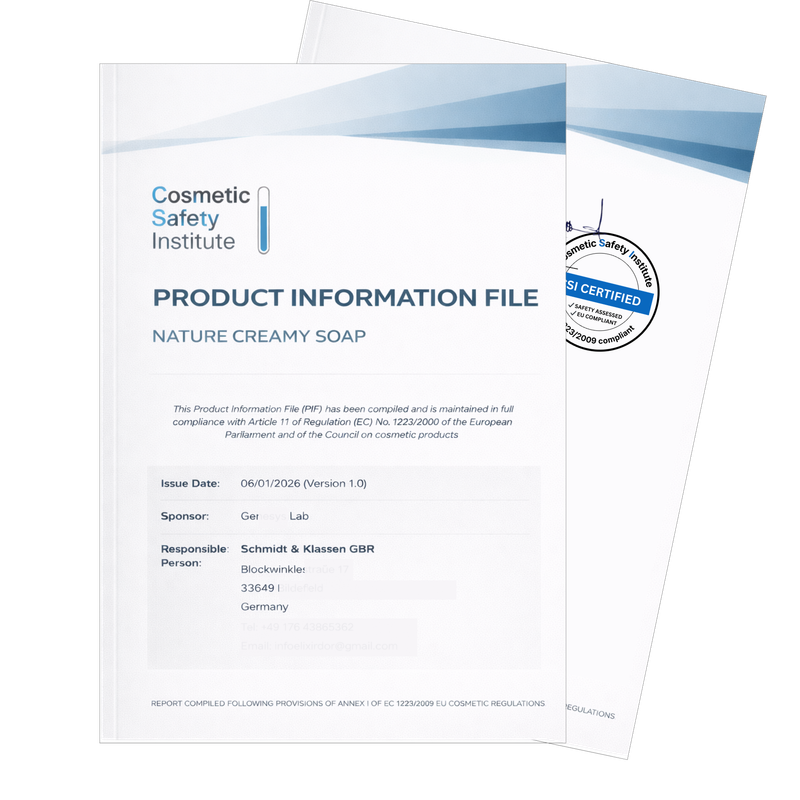
We create and structure your Product Information File (PIF / PID) in accordance with Article 11 of Regulation (EC) No 1223/2009.
The PIF is the legally required product file for your cosmetic product and must be complete before it can be placed on the market.
The Product Information File (PIF) contains the regulatory evidence on the basis of which a cosmetic product is assessed, documented and marketed in the EU.
According to Article 11 of Regulation (EC) No 1223/2009, the responsible person must maintain a complete PIF for each cosmetic product and make it available to the competent market surveillance authorities.
Without a complete Product Information Document (PIF), the legally required product documentation is missing. Therefore, the product is not marketable under regulations and may not be made available on the EU market in compliance with the law.
In short: Without PIF, you cannot legally sell your cosmetic product.
The PIF must be kept available for ten years after the last placing on the market of the respective product batch.
You will receive a structured product information file in accordance with Article 11 of Regulation (EC) No 1223/2009 as a regulatory product file for your cosmetic product.
The PIF provides the legal documentation basis for CPNP notification according to Article 13 and the lawful placing of your product on the market in the EU.
This provides the necessary product documentation to legally prepare your cosmetics for market launch. Without complete Product Information Documentation (PIF), your product will not be marketable under regulations.
We will handle the notification of your cosmetic product in the Cosmetic Product Notification Portal (CPNP) in accordance with Article 13 of Regulation (EC) No 1223/2009.
CPNP notification is the legally required notification of a cosmetic product before it is first placed on the market in the European Union.
The CPNP (Poison Control Network) is used to deposit relevant product data with the European Commission and make it available to the competent authorities and poison control centers.
According to Article 13 of Regulation (EC) No 1223/2009, the responsible person must notify the cosmetic product in the CPNP before placing it on the market.
Without CPNP notification, your cosmetic product cannot be legally made available or sold on the EU market – even if CPSR, PIF, label and production are already in place.
In short: Without CPNP notification, there is no legal market entry into the EU.
CPNP notification does not replace CPSR or PIF. It requires that the regulatory product documentation is available and that the information in the portal matches the product, formulation, and labeling.
You will receive the completed CPNP notification in accordance with Article 13 of Regulation (EC) No 1223/2009 for your cosmetic product.
With the successful CPNP notification, the legally required product notification for EU market entry has been fulfilled. Your product can therefore – provided it has a CPSR, PIF, GMP-compliant manufacturing process, and legally compliant labeling – be fully prepared for sale from a regulatory perspective.
We coordinate the laboratory tests required for your safety assessment and compile the results for CPSR and PIF in a regulatory-compliant manner.
Laboratory tests provide the evidence on the basis of which product safety is assessed in accordance with Article 3, the safety assessment in accordance with Article 10 and the documentation in accordance with Annex I of Regulation (EC) No 1223/2009.
Laboratory tests verify that your product remains safe, stable, and microbiologically sound throughout its intended shelf life.
Depending on the product type, formulation, packaging and application, the following may be particularly necessary:
According to Annex I of Regulation (EC) No 1223/2009, stability, microbiological quality, packaging material and safety-related product characteristics must be taken into account in CPSR.
Without reliable test data, the Safety Assessor cannot determine whether your product remains safe throughout its entire shelf life. Missing stability, microbiological, or packaging data may prevent the creation of a reliable CPSR or result in incomplete product documentation for market launch.
In short: Without the required test results, your cosmetic product cannot be safely assessed from a regulatory perspective and cannot be legally launched on the market.
You will receive reliable laboratory reports as a basis for the safety assessment in accordance with Article 10 and Annex I of Regulation (EC) No 1223/2009.
The test results provide the data basis for a professional evaluation of your product regarding stability, microbiological quality, and packaging. This prevents your CPSR from being rejected due to missing safety documentation, thus avoiding a situation where your product is held up before market launch.
We support you in developing a safe, functional and regulatory-compliant cosmetic formulation – as the basis for a successful market launch.
Product formula that is testable and regulatory approved.
Well-planned product development reduces subsequent regulatory risks and accelerates the entire approval process. We ensure that your formulation is designed from the outset to seamlessly transition to subsequent steps such as safety assessment, documentation, and market launch.
We check your product labelling and INCI list in accordance with Article 19 of Regulation (EC) No 1223/2009 and advertising claims in accordance with Article 20 of Regulation (EU) No 655/2013.
Legally compliant labeling is a prerequisite for your cosmetic product to be legally made available and sold in the EU.
The label and INCI check includes in particular:
According to Article 19 of Regulation (EC) No 1223/2009, cosmetic products may only be made available on the EU market with complete and correct mandatory information.
If mandatory information is missing, the INCI list is incorrect, or claims are unsubstantiated, the product is not labelled in accordance with legal requirements. This can lead to complaints from market surveillance authorities, relabeling, sales suspension, or product recalls.
In short: Without a legally compliant label, your cosmetic product is not marketable – even if CPSR, PIF and CPNP are already available.
You will receive a regulatory assessment of your label with specific correction instructions for labelling in accordance with Article 19 of Regulation (EC) No 1223/2009.
With certified labeling, you create the prerequisite for legally labeling, notifying, and marketing your cosmetic product in the EU. Errors are detected before printing and before market entry – not only through authorities or cease-and-desist letters.
We review the existing manufacturing practices and prepare the GMP documentation for your product file in accordance with Article 8 of Regulation (EC) No 1223/2009.
The manufacture of cosmetic products must comply with Good Manufacturing Practice (GMP). Application of the harmonized standard EN ISO 22716:2007 establishes a presumption that the GMP requirement is met.
A GMP statement documents that the manufacturing of your cosmetic product is carried out according to the principles of cosmetic GMP.
According to Article 8 of Regulation (EC) No 1223/2009, the manufacture of cosmetic products must be carried out in accordance with GMP.
The GMP declaration is also a mandatory component of the product information file according to Article 11. If proof of GMP-compliant manufacturing is missing, your PIF is regulatory incomplete.
In short: Without documented GMP compliance, a legally required component of your product documentation is missing – your cosmetic product is therefore not fully prepared for entry into the EU market.
You will receive a GMP declaration in accordance with Articles 8 and 11 of Regulation (EC) No 1223/2009 for inclusion in your product information file.
The GMP declaration documents an essential part of your regulatory product file. It ensures that CPSR, PIF, and manufacturing information are consistent and that your product can be prepared for lawful distribution in the EU.
Important: A GMP statement does not replace ISO 22716 certification and a full audit of the manufacturing operation.

We accompany your cosmetic product from the initial idea through formulation, testing and regulatory review to production and delivery.
Full service means: All key steps for the development and market launch of your cosmetic product are coordinated in a structured manner from a single source.
This includes product development, GMP statement according to ISO 22716, laboratory tests, label/INCI check, as well as production and fulfillment.
Cosmetic projects often fail not because of the idea, but because of a lack of coordination between formulation, testing, labeling, regulation and production.
Errors in these areas quickly lead to delays, additional costs, or regulatory risks. A clear, full-service process ensures that your product is marketable, documented, and professionally implementable from the outset.
A developed, tested, regulatory prepared and ready-to-sell cosmetic product.
You save time, avoid costly mistakes and receive a clearly guided process from idea to market launch. We coordinate development, testing, labeling, GMP verification and production for you – so that your cosmetic product can go on sale faster, more safely and professionally.
We oversee the production of your cosmetic product in compliance with all regulatory requirements and ensure that your production meets the requirements of the EU Cosmetics Regulation.
Production involves the manufacture of a cosmetic product under controlled conditions. All processes – from raw material processing to filling – must comply with Good Manufacturing Practice (GMP) requirements to ensure quality and safety.
Production involves the manufacture of a cosmetic product under controlled conditions. All processes – from raw material processing to filling – must comply with Good Manufacturing Practice (GMP) requirements to ensure quality and safety.
Finished, tested product batch.
A structured production process ensures that your product is manufactured under the correct conditions and meets all requirements for the CPSR safety assessment. This allows your product to be launched and sold without delay.