
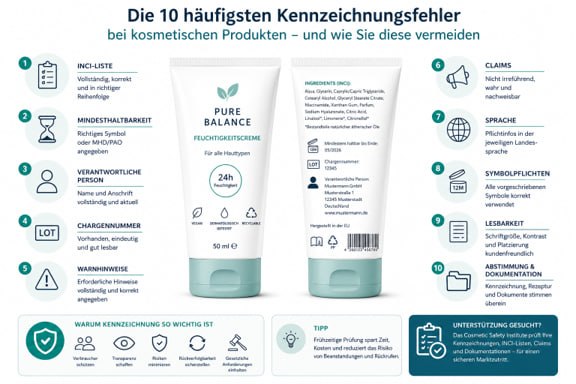
Developing a cosmetic product often involves a great deal of time, passion, and investment. It is therefore all the more frustrating when a product is rejected or even withdrawn from the market due to incorrect labeling.
In fact, labeling errors are among the most frequent reasons for regulatory complaints in the cosmetics sector. Many of these errors do not arise from negligence, but because the requirements of the EU Cosmetics Regulation are complex and constantly evolving.
Even a seemingly minor discrepancy on the label can have legal consequences.
In this article, we show the ten most common labeling errors in cosmetic products and explain how manufacturers can avoid these risks.
Why labeling is so important
The labeling of a cosmetic product serves far more than just an informative purpose.
It serves to:
- to protect consumers
- To create transparency about ingredients
- To minimize risks
- to ensure traceability
- to comply with legal requirements
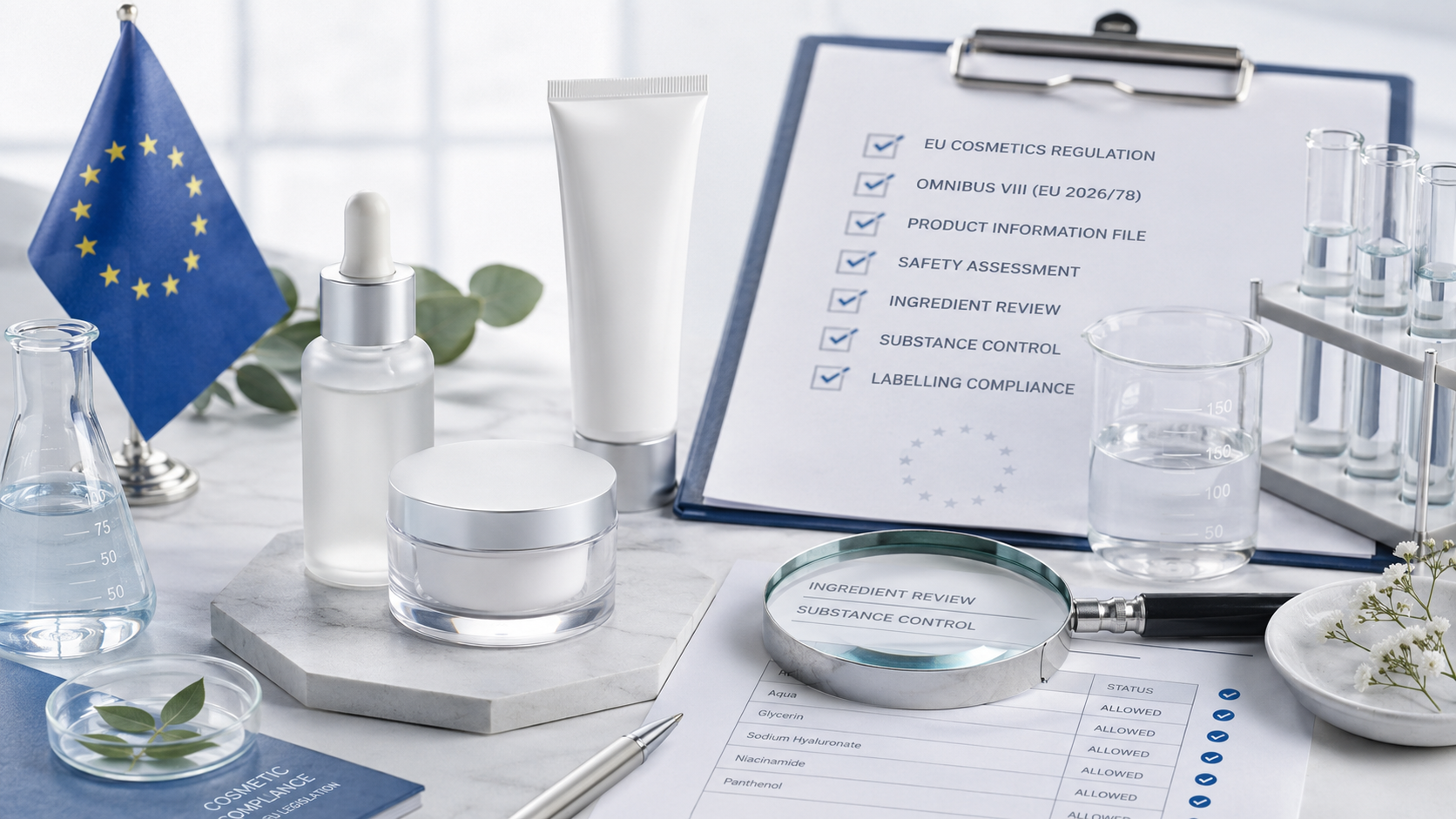
The legal basis is the EU Cosmetics Regulation (EC) No. 1223/2009.
Error No. 1: Incomplete or incorrect INCI list
The INCI list (International Nomenclature of Cosmetic Ingredients) is one of the most important mandatory details on cosmetic products.
In practice, the following problems frequently occur:
- Incorrect INCI names
- Outdated raw material names
- Incorrect order of ingredients
- Missing fragrance declarations
- Undeclared dyes
Especially when recipes are adjusted, changes are often not consistently updated on the labels.
Error No. 2: Incorrect indication of the best before date
Cosmetic products must either have a best-before date or the so-called Period-After-Opening (PAO) symbol.
Typical mistakes:
- Incorrect symbol
- Missing month information
- Use of a best-before date instead of PAO
- Lack of labeling despite legal obligation
Complaints frequently arise, especially with products that have a shorter shelf life.
Error No. 3: Missing or incomplete information on the responsible person
Within the European Union, every cosmetic product requires a responsible person.
The name and address of this person must be clearly visible on the packaging.
Common mistakes:
- Missing address
- Incomplete company data
- Outdated contact details
- Incorrect information provided by the importer
Especially with private label products, uncertainties regularly arise in this area.
Error No. 4: Missing batch number
The batch number serves to trace a product.
It enables manufacturers and authorities to clearly identify affected products in the event of quality problems.
Missing or illegible batch numbers can cause significant problems – especially in the case of product recalls.
Error No. 5: Missing warning labels
Certain ingredients or product categories require mandatory warning labels.
Typical examples include:
- Hair dye
- Products containing alpha hydroxy acids
- Sun protection products
- Products for professional users
Missing warning labels are a regular complaint during market surveillance.
Mistake No. 6: Misleading advertising claims
Many manufacturers focus on product development and underestimate the regulatory requirements for advertising claims.
Problematic examples:
- “100% free of chemicals”
- “Medically effective”
- “Guaranteed allergy-free”
- “Heals skin problems”
Cosmetic products must not make any medical claims.
All claims must be verifiable, truthful, and scientifically substantiated.
Mistake No. 7: Wrong language on the label
Mandatory information must be understandable to consumers.
Different language requirements apply depending on the country of sale.
A common mistake is to offer products exclusively with English labeling in German-speaking markets.
This applies in particular to:
- Warning notices
- Instructions for use
- Functional descriptions
Error No. 8: Missing symbol requirements
The EU cosmetics regulation prescribes various symbols.
These include, for example:
- PAO symbol
- hourglass symbol
- Reference to enclosed information
- Recycling labels
Missing or incorrectly used symbols regularly lead to complaints.
Error No. 9: Insufficient readability
Even if all mandatory information is present, it must also be legible.
Typical problems:
- Font sizes too small
- Poor contrast
- Hidden information
- Unclear design
From a consumer perspective, all relevant information must be easily recognizable.
Error No. 10: Labeling does not match product documentation
One of the most critical errors occurs when the labeling, CPSR, product information file (PIF) and actual formulation do not match.
This often happens after:
- Recipe changes
- Switching suppliers
- Packaging adjustments
- Product relaunches
The result is inconsistencies that quickly become apparent during audits or official inspections.
Why many labeling errors are only discovered late
Many companies only check their labeling shortly before the sales launch.
At this point, packaging is often already produced, and mistakes cause unnecessary costs.
Early regulatory review not only saves time and money, but also significantly reduces the risk of market complaints.
How the Cosmetic Safety Institute can help
Regulatory review of labeling is one of the most important steps before a cosmetic product is launched on the market.
The Cosmetic Safety Institute supports manufacturers, start-ups and brand owners in verifying:
- Product labels
- INCI lists
- Claims
- Mandatory information
- Packaging texts
- Product documentation
By combining regulatory expertise, practical industry knowledge and comprehensive understanding of the EU Cosmetics Regulation, we help companies to identify potential risks early and avoid costly mistakes.
Conclusion
Errors in the labeling of cosmetic products are among the most frequent causes of complaints from authorities and competitors.
Many of these errors can be avoided through early regulatory review.
Ensuring that labeling, safety assessment, product information file and product formulation are fully aligned creates the basis for legally compliant and successful marketing.
Do you want to have your product labeling checked or are you unsure whether all legal requirements are met? The Cosmetic Safety Institute team will be happy to assist you with the regulatory assessment of your cosmetic products.
SEO keywords: cosmetic labeling, cosmetic labeling regulations, INCI errors, cosmetic label, EU cosmetic regulations, cosmetic product labeling, cosmetic compliance