
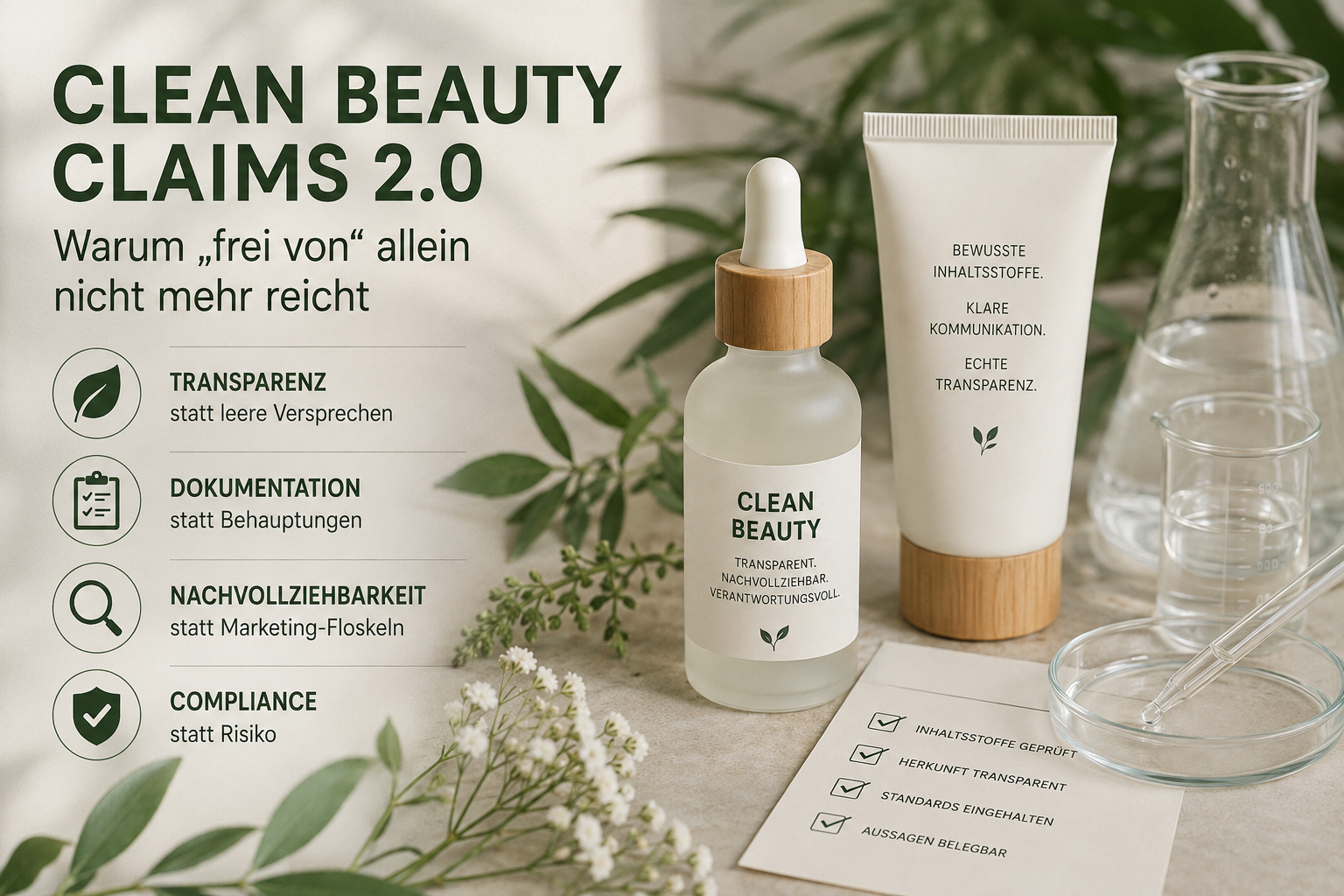
“Clean Beauty” has evolved from a niche trend into a clear consumer expectation. Cosmetic brands are no longer expected to offer effective products only. They are also expected to explain which ingredients they use, where those ingredients come from, and which standards guide their selection.
However, many brands still reduce Clean Beauty to so-called “free from” claims:
- paraben-free
- silicone-free
- microplastic-free
- free from artificial fragrances
- free from harmful chemicals
These claims appear simple, understandable, and commercially effective. From a regulatory perspective, however, they are not automatically compliant.
A “free from” claim often communicates more than the absence of a specific substance. It can create the impression that the advertised product is safer, healthier, or superior to comparable products.
This implied message must also be substantiated.
What a Clean Beauty Claim Really Communicates
A Clean Beauty claim is not merely a factual statement about a formulation. It is part of a broader marketing position that may suggest safety, purity, naturalness, or exceptional transparency.
This creates several layers of meaning:
- Explicit claim: A specific substance is not contained in the product.
- Implicit claim: The excluded substance is undesirable or problematic.
- Comparative claim: The advertised product is better or safer than products containing that substance.
The second and third layers are often underestimated in marketing.
A product can be paraben-free without being more natural, more sustainable, or more transparent. Similarly, a product may be free from conventional microplastics while still containing other synthetic polymers.
The absence of individual ingredients is therefore not automatic proof of a “clean” or superior product concept.
Why Negative Claims Are Regulatorily Sensitive
Negative claims are attractive because they are easy to understand. It is much easier to communicate what a product does not contain than to explain what is used instead and why that alternative is relevant.
This is precisely where the risk lies.
A claim such as “free from harmful chemicals” may imply that other legally marketed cosmetic products contain harmful substances. At the same time, it remains unclear which substances are meant and which scientific or regulatory criteria support the claim.
This type of communication can lead consumers to an incorrect assessment of risk.
The more strongly a claim suggests safety or superiority, the stronger the supporting evidence must be.
From Absence Claims to Genuine Transparency
Modern Clean Beauty communication should not focus solely on exclusions. The priority should be to communicate product attributes that are specific, understandable, and verifiable.
Attributes Instead of Fear-Based Messaging
Rather than broadly warning against supposedly problematic ingredients, brands should explain which standards and quality criteria they apply.
Problematic:
Free from harmful chemicals.
Better:
The ingredients used are assessed according to defined quality and safety criteria.
Or:
Documented origin and quality information is available for selected raw materials.
This shifts the focus from fear-based communication to substantiated product characteristics.
Documentation Instead of Assertion
A claim is only as reliable as the documentation supporting it.
Brands using a “free from” claim should be able to demonstrate that the relevant substance is neither deliberately added nor introduced through raw materials, fragrance mixtures, manufacturing aids, or technical processes in a way that contradicts the claim.
Depending on the claim, the required evidence may include:
- raw-material specifications
- supplier declarations
- certificates of analysis
- formulation and manufacturing records
- test reports
- regular quality controls
- contractual assurances from manufacturers and suppliers
Without this documentation, the claim remains a marketing assertion.
Context Instead of Blanket Exclusions
A meaningful claim should not only explain what is absent. It should also clarify why the information is relevant to the consumer.
Brands should therefore ask:
- Why is the substance excluded?
- Which alternative is used?
- What concrete product benefit does that alternative provide?
- Is there a recognised standard?
- Can the claim be explained clearly and factually?
A “free from” claim without context can easily appear to warn consumers against ingredients that may be completely legal and safe when used correctly.
Ingredient Transparency Is the Baseline, Not Automatically a USP
Providing an INCI ingredient list is a regulatory requirement. On its own, however, it does not create a distinctive Clean Beauty positioning.
Consumers increasingly expect additional information:
- Where do the raw materials come from?
- Which criteria were used to select them?
- Under which conditions were they sourced?
- What function does each ingredient perform?
- Which quality standards are applied?
- How traceable is the supply chain?
This information can create meaningful differentiation. At the same time, it increases the need for substantiation.
Brands using terms such as “natural,” “sustainable,” “ethically sourced,” “regional,” or “responsibly sourced” must be able to document those claims.
An attractive sourcing story is not a substitute for evidence.
Specific Risks for Private-Label and Influencer Brands
Private-label brands often rely heavily on information provided by manufacturers. This can become problematic when the information is incomplete, unclear, or insufficiently documented.
The brand under whose name the product is marketed remains responsible for the communication made to consumers.
This means:
- Manufacturer claims should not be adopted without review.
- Raw-material information should be available in writing.
- Marketing statements must match the actual formulation.
- Changes to ingredients, suppliers, or processes must be considered.
- Claim-related evidence should be contractually secured.
Influencer brands carry the same responsibility. Reach, personal credibility, and community trust do not replace regulatory substantiation.
In fact, the stronger a personal brand is associated with authenticity and transparency, the greater the reputational risk when claims are contradictory or unsupported.
Practical Example: “Free From Artificial Fragrances”
A brand launches a product line under the promise “Clean & Transparent.” The INCI list is displayed prominently on the packaging. The brand also uses the claim:
Free from artificial fragrances.
However, the INCI list contains the term “Parfum.”
This is not automatically a contradiction. However, the collective term “Parfum” does not tell consumers whether the fragrance composition consists of natural, nature-identical, or synthetic components.
This creates several risks.
Risk 1: Unclear Consumer Expectations
Many consumers will understand “free from artificial fragrances” to mean that all fragrance components are of natural origin.
If the brand cannot meet that expectation, the claim may be misleading.
Risk 2: Missing Supplier Documentation
The brand must be able to determine which components are included in the fragrance mixture and how the supplier defines the terms used.
A verbal statement such as “the fragrance is natural” is not sufficient.
Risk 3: Contradictory Overall Communication
A transparency promise raises the standard against which the brand is judged. The more strongly a brand promotes openness and traceability, the more problematic vague or general claims become.
This example shows that a claim may be well intentioned and still create a misleading overall impression.
The Most Common Clean Beauty Claim Mistakes
1. Legally Permitted Ingredients Are Broadly Discredited
Claims such as “without harmful ingredients” or “free from toxic chemicals” are particularly risky because they may generate fear and unfairly discredit competing products.
2. The Absence of Individual Ingredients Is Equated With Product Safety
The safety of a cosmetic product does not result from the exclusion of individual ingredient groups. It depends on factors such as formulation, concentration, exposure, intended use, and the overall safety assessment.
3. Claims Are Assessed Only Against the Formula
Raw materials, fragrance mixtures, processing aids, and potential impurities may also be relevant to a “free from” claim.
4. Marketing Terms Are Not Defined Internally
When terms such as “clean,” “natural,” or “ethical” are used, the brand should clearly document the criteria behind those terms.
5. Supplier Statements Are Accepted Without Verification
A data sheet or an email from a manufacturer is not automatically sufficient evidence for a consumer-facing claim.
6. Packaging, Website, and Social Media Communicate Different Messages
Claims must remain consistent across all communication channels. A cautious statement on packaging can be undermined by exaggerated wording on social media or in advertising.
What Brands Should Do Now
1. Conduct a Claims Audit
Record every statement used in connection with the product:
- packaging
- website content
- product pages
- social media posts
- influencer briefings
- advertisements
- press materials
- sales presentations
Do not review explicit wording only. Images, symbols, colours, icons, and overall presentation can also create specific consumer expectations.
2. Categorise the Claims
A practical classification may include:
- legally required information
- objectively verifiable product characteristics
- certification- or standard-based claims
- sensory or subjective claims
- sustainability and sourcing claims
- “free from” and comparative claims
- high-risk safety or health-related claims
The greater the potential for consumers to be misled, the more comprehensive the review should be.
3. Create an Evidence File for Every Claim
Each claim file should contain:
- the exact wording
- the intended meaning
- the likely consumer interpretation
- the scientific or technical basis
- relevant supplier documentation
- the responsible internal function
- the date of the most recent review
- required review intervals
This turns a marketing statement into a controlled compliance process.
4. Involve Suppliers Contractually
For private-label products and externally developed formulations, manufacturers and suppliers should be required to provide complete and current information.
This should include:
- raw-material origin
- composition of complex mixtures
- changes to formulations
- certification status
- analytical evidence
- confirmation of claim-relevant characteristics
5. Reassess Claims Regularly
A claim that was reviewed once does not remain valid automatically.
Formulations, suppliers, manufacturing processes, market standards, and regulatory expectations can change. Claim reviews should therefore form part of change control and quality management.
Clean Beauty Claims 2.0: Substantiation Becomes a Competitive Advantage
The next stage of Clean Beauty is not about creating longer exclusion lists.
It is about verifiable transparency.
Consumers do not only want to know what a product does not contain. They want to understand:
- what the product contains,
- why those ingredients are used,
- where they come from,
- how they are assessed,
- and whether the brand’s statements can be substantiated.
This is where genuine differentiation begins.
Credible transparency requires clear standards, structured documentation, and reliable supply chains. Brands that invest in these processes can communicate far more convincingly than competitors that use Clean Beauty merely as an attractive label.
Transparency does not mean: “We say it.” Transparency means: “We can prove it.”
Review Cosmetic Claims Before Product Launch
Regulatory compliance is not a one-time task. New products, formulation changes, additional markets, or new campaigns may require claims to be reassessed.
A structured claims review helps brands to:
- identify potentially misleading statements early,
- avoid unnecessary packaging changes,
- reduce risks before launch,
- request the correct supplier documentation,
- and build defensible points of differentiation.
Brands that review claims only after production or launch risk expensive corrections.
Brands that integrate claims compliance into product development and brand strategy create a stronger foundation for credible Clean Beauty communication.
Would You Like Your Cosmetic Claims Reviewed?
A structured claims review identifies which statements are substantiated, where supporting evidence is missing, and which formulations may create regulatory risk.
Have your existing claims or planned product promises reviewed before launch.
Disclaimer: This article is intended for general information only and does not constitute legal advice. Cosmetic claims should always be assessed based on the individual product, target market, and specific circumstances.