
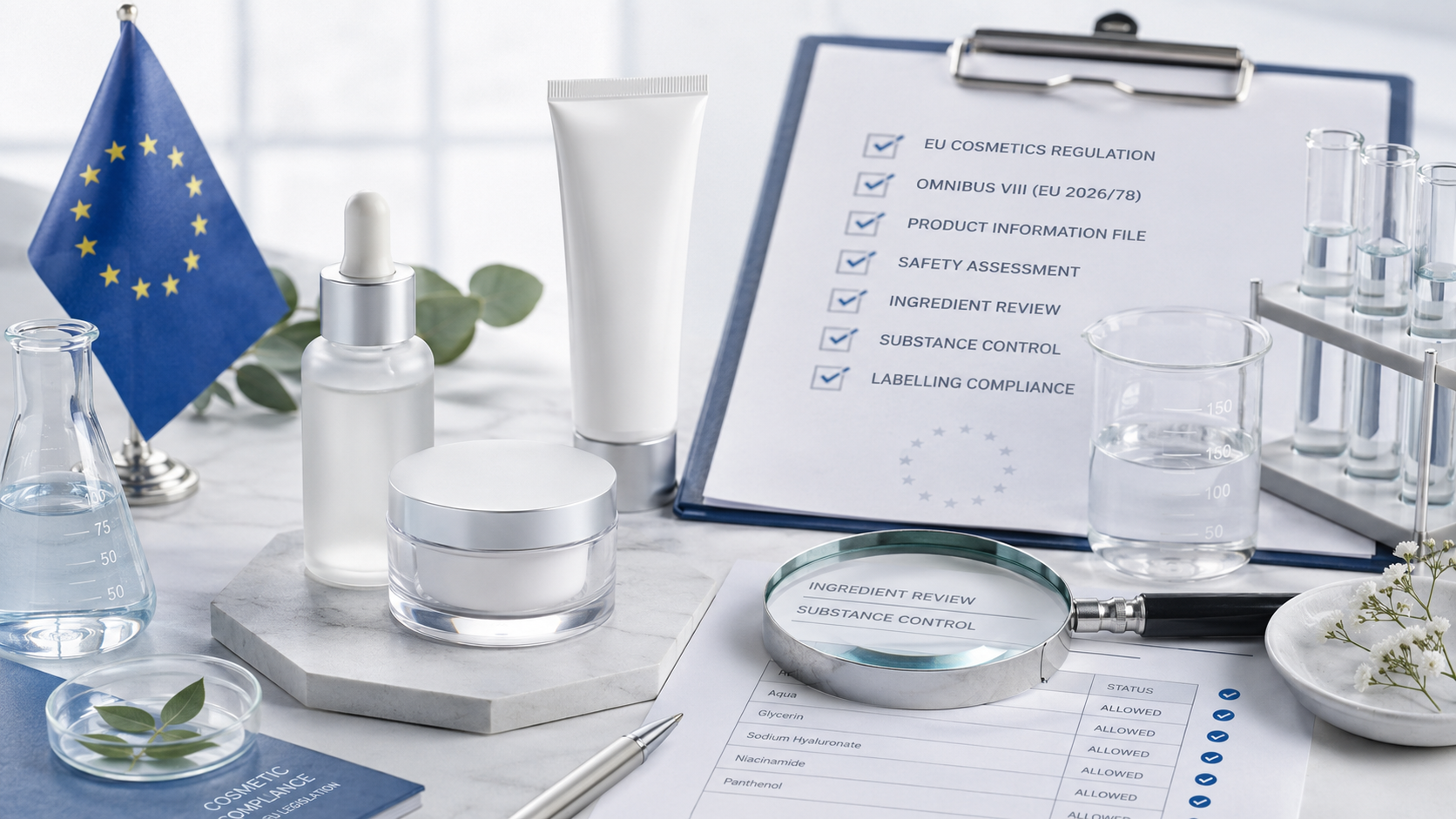
Omnibus VIII (EU 2026/78): Is Your Cosmetic Product Still Compliant Since May 2026?
Since 1 May 2026, new requirements have applied in the European Union to certain substances used in cosmetic products. The legal basis is Commission Regulation (EU) 2026/78, commonly referred to as “Omnibus VIII”. It amends several annexes to Regulation (EC) No 1223/2009 on cosmetic products.
The regulation focuses on substances newly classified as carcinogenic, mutagenic, or toxic to reproduction. The new provisions concerning silver and Hexyl Salicylate are particularly relevant to the cosmetics industry. In addition, further substances have been prohibited and existing requirements for certain preservatives have been amended.
Manufacturers, responsible persons, importers, and private-label brands should therefore ask one central question:
Do your formulations, safety assessments, and product files still comply with the applicable requirements since 1 May 2026?
What Is the Omnibus VIII Regulation?
Commission Regulation (EU) 2026/78 was adopted on 12 January 2026 and published in the Official Journal of the European Union on 13 January 2026. It has applied since 1 May 2026.
The regulation amends Annexes II, III, IV, and V to Regulation (EC) No 1223/2009 on cosmetic products. These amendments introduce new substance prohibitions, restrictions of use, and maximum concentrations directly into European cosmetics law.
The changes are based on the harmonised classification of certain substances under Delegated Regulation (EU) 2024/2564 amending the European CLP Regulation.
Why Are CMR Substances Regulated in Cosmetics?
CMR stands for:
- Carcinogenic: capable of causing cancer
- Mutagenic: capable of causing genetic mutations
- Reprotoxic: toxic to reproduction
Depending on the strength of the scientific evidence, substances are classified in categories 1A, 1B, or 2.
Article 15 of the Cosmetics Regulation generally provides that substances classified as CMR must not be used in cosmetic products. Exceptions may be possible under strictly defined conditions. These conditions may include a scientific safety assessment and the inclusion of the substance in a relevant annex to the Cosmetics Regulation.
This approach has been applied to certain uses of silver, Hexyl Salicylate, and o-Phenylphenol.
What Changes Does Omnibus VIII Introduce for Cosmetic Products?
Omnibus VIII introduces three main regulatory measures:
- New prohibitions for several CMR substances
- Restricted authorisation of certain uses of silver and Hexyl Salicylate
- Amended provisions for o-Phenylphenol and Sodium o-Phenylphenate
A screening limited to the terms “silver” and “Hexyl Salicylate” is therefore not sufficient. Companies should review all substance entries amended by the regulation.
Silver in Cosmetics: Particle Size and Intended Use Are Critical
Silver with CAS number 7440-22-4 has been classified as a category 2 CMR substance due to reproductive toxicity.
The new regulation distinguishes between different particle sizes:
- Nano silver: particle diameter above 1 nm and up to 100 nm
- Silver powder: particle diameter above 100 nm and below 1 mm
- Massive silver: particle diameter of 1 mm or more
Nano Silver and Massive Silver
Nano silver and massive silver have been added to Annex II of the Cosmetics Regulation. Annex II contains substances prohibited in cosmetic products.
Companies should therefore not assume that every form of silver remains permitted as a colourant or functional ingredient.
Silver Powder in Toothpaste and Mouthwash
Silver powder with a particle size above 100 nm and below 1 mm has been added to Annex III. It may be used under the specified conditions:
- Toothpaste: maximum 0.05%
- Mouthwash: maximum 0.05%
The entry for the colourant CI 77820 in Annex IV has also been amended. Permitted use is therefore linked to specific particle sizes, product categories, and concentrations.
Important: The INCI term “Silver” alone is not sufficient for a compliance assessment. Information on particle size, particle distribution, function, and concentration in the finished product is required.
Hexyl Salicylate: New Maximum Concentrations Since May 2026
Hexyl Salicylate, chemically known as hexyl 2-hydroxybenzoate, has been classified as a category 2 substance toxic to reproduction.
In cosmetic products, the substance is typically used as a fragrance ingredient or as part of a complex perfume composition. It should not be confused with an authorised cosmetic UV filter.
Omnibus VIII adds Hexyl Salicylate to Annex III of the Cosmetics Regulation and introduces product-specific maximum concentrations.
| Product category | Maximum concentration |
|---|---|
| Hydroalcoholic fragrance products, excluding products for children under three years of age | 2.0% |
| Rinse-off products, unless subject to the specific restriction for children | 0.5% |
| Leave-on products, unless subject to the specific restriction for children | 0.3% |
| Toothpaste | 0.001% |
| Mouthwash | 0.001% |
| Certain products for children under three years of age | 0.1% |
Additional restrictions apply to products intended for children under three years of age. Certain product categories are excluded or may contain Hexyl Salicylate only under the expressly defined conditions.
Why the Fragrance Composition Must Be Reviewed
Hexyl Salicylate may not always appear as a separately dosed raw material in the finished product formula. It may be present as a component of a complex fragrance or perfume mixture.
A correct assessment therefore requires:
- the concentration of the fragrance mixture in the finished product,
- the proportion of Hexyl Salicylate in the fragrance mixture,
- the product category under the new regulation,
- the calculated final concentration in the finished product,
- current documentation from the fragrance supplier.
The relevant calculation can be expressed in simplified form as follows:
Percentage of fragrance mixture in the product × percentage of Hexyl Salicylate in the fragrance mixture = final concentration of Hexyl Salicylate
A general supplier statement that a fragrance mixture is “IFRA compliant” does not replace this product-specific calculation.
Further Substances Prohibited by Omnibus VIII
In addition to certain forms of silver, the regulation adds further newly classified CMR substances to Annex II of the Cosmetics Regulation.
These include, among others:
- certain multi-walled carbon nanotubes,
- Acetoxime,
- 2,3-Epoxypropyl neodecanoate,
- N,N’-Methylenebisacrylamide,
- Trimethyl borate,
- certain plant protection substances and industrial chemicals.
Some of these substances may not be deliberately used as cosmetic ingredients. However, they may still be relevant in relation to raw materials, technical mixtures, impurity profiles, or manufacturing processes.
The screening should therefore not be based exclusively on the INCI list of the finished product.
What Changes Apply to o-Phenylphenol?
o-Phenylphenol has been classified as a category 2 CMR substance due to carcinogenic properties. It was already permitted as a preservative in cosmetic products.
Omnibus VIII amends its entry in Annex V and additionally covers Sodium o-Phenylphenate.
The following maximum concentrations apply to individual or combined use, calculated as phenol:
- Rinse-off products: maximum 0.2%
- Leave-on products: maximum 0.15%
Where o-Phenylphenol and Sodium o-Phenylphenate are used together, their combined concentration must not exceed the applicable maximum limit.
The following restrictions also apply:
- no applications that may lead to lung exposure through inhalation,
- no use in oral care products,
- avoid contact with the eyes.
Is There a Sell-Through Period for Existing Stock?
Regulation (EU) 2026/78 states that the amendments apply from 1 May 2026. It does not provide a separate general transitional or sell-through period for products that do not comply with the new requirements.
This differs from legal acts that expressly provide separate dates for placing products on the market and making them available on the market.
It is therefore not legally robust to assume that products manufactured or initially distributed before 1 May 2026 may automatically continue to be sold without limitation.
For affected products, companies should review at least the following:
- When was the product first placed on the market?
- Has it continued to be made available on the market since 1 May 2026?
- Does the formulation comply with the annexes applicable since that date?
- Are non-compliant stocks still held by retailers or distributors?
- Are blocking, withdrawal, reformulation, or destruction measures required?
The assessment should be product-specific and distribution-specific. A distinction should be made between manufacturing, placing on the market, making available on the market, and sale to the final consumer.
Which Companies Are Affected by Omnibus VIII?
The regulation is particularly relevant to:
- cosmetic manufacturers,
- responsible persons established in the EU,
- importers from non-EU countries,
- private-label and white-label brands,
- brands using externally developed fragrance compositions,
- contract manufacturers,
- raw-material and fragrance suppliers,
- retailers holding older stock.
Private-label brands should not rely solely on a general compliance statement from the manufacturer. The responsible person must ensure that the specific finished product complies with the applicable legal requirements.
Omnibus VIII Compliance Checklist for Cosmetic Companies
1. Screen All Formulations
Review all active formulations at least for:
- Silver or CI 77820,
- Hexyl Salicylate,
- o-Phenylphenol,
- Sodium o-Phenylphenate,
- the newly prohibited substances added to Annex II.
2. Update Raw-Material Documentation
Request current and reliable documentation from suppliers, including:
- complete specifications,
- composition data for complex mixtures,
- allergen and fragrance documentation,
- particle-size information for silver,
- certificates of analysis,
- updated regulatory compliance statements.
3. Calculate Final Concentrations
Do not assess only the use level of a raw material. The decisive factor is the concentration of the regulated substance in the finished cosmetic product.
4. Assign the Correct Product Category
The permitted concentration of Hexyl Salicylate depends on the applicable product category. Incorrect classification may lead directly to an incorrect compliance conclusion.
5. Update the Cosmetic Product Safety Report
Assess whether the Cosmetic Product Safety Report, particularly Part A and Part B, must be updated. New concentration limits, revised raw-material data, and reformulations must be reflected in the safety assessment.
6. Review the Product Information File
The Product Information File should accurately reflect the current formulation, supporting evidence, manufacturing information, and safety assessment.
7. Check the CPNP Notification
Where a product is reformulated, assess whether the existing notification in the Cosmetic Products Notification Portal must be updated.
8. Review Packaging and Labelling
A formulation change may affect the INCI list, warnings, claims, and other product information.
9. Assess Warehouse and Trade Stock
Identify:
- affected batches,
- manufacturing dates,
- storage locations,
- stocks held by distributors,
- quantities already delivered,
- required corrective measures.
10. Document All Decisions
Document the review, supplier information, calculations, decisions, and any corrective actions in a clear and traceable manner.
Common Implementation Errors
Reviewing Only the INCI List
Complex raw materials and fragrance mixtures may contain regulated substances that are missed during a superficial formula review.
Assessing Silver Without Particle-Size Data
The regulatory status depends significantly on particle size and intended use.
Treating Hexyl Salicylate as a UV Filter
Hexyl Salicylate is typically used as a fragrance ingredient. The new maximum concentrations are linked to specific product categories and exposure scenarios.
Assuming an Automatic Sell-Through Period
Omnibus VIII does not provide an express general sell-through period. Existing stock should therefore not continue to be distributed without a documented individual assessment.
Accepting a General Supplier Declaration
A generic statement such as “EU compliant” is not sufficient where concentration, particle size, product category, or composition cannot be verified.
Reviewing Only New Products
The regulation also affects existing products, ongoing production, and stock already held in warehouses or by distributors.
When Is Reformulation Required?
Reformulation may be required where:
- a newly prohibited substance is present,
- Hexyl Salicylate exceeds the applicable maximum concentration,
- the silver form used is no longer permitted,
- particle size cannot be sufficiently documented,
- the intended product category is not covered by the permitted use,
- the supplier cannot provide the required evidence.
Where reformulation is necessary, regulatory compliance should not be assessed in isolation. Stability, preservation, compatibility, efficacy, odour, colour, and packaging interaction may also need to be reassessed.
Conclusion: Omnibus VIII Requires More Than a Basic Ingredient Screening
Regulation (EU) 2026/78 has applied since 1 May 2026 and changes the regulatory conditions for several substances relevant to cosmetic products.
Particular attention should be given to:
- silver and the relevant particle size,
- Hexyl Salicylate in fragrance mixtures,
- product-specific maximum concentrations,
- o-Phenylphenol and Sodium o-Phenylphenate,
- newly prohibited CMR substances,
- existing warehouse and trade stock.
A reliable compliance review combines formulation screening, supplier documentation, concentration calculations, safety assessment, and stock management.
The key question is not whether a product was once compliant before May 2026. The key question is whether it meets the requirements applicable since 1 May 2026.
Is Your Cosmetic Product Affected by Omnibus VIII?
A structured compliance audit identifies which formulations are affected, which documents are missing, and where reformulation or stock-related decisions may be required.
Our review may include:
- formulations and raw-material documentation,
- silver forms and particle sizes,
- Hexyl Salicylate concentrations,
- product categories and maximum limits,
- safety reports and Product Information Files,
- existing warehouse and distribution stock.
You receive a clear risk assessment and a prioritised action plan.
Frequently Asked Questions About Omnibus VIII
Since When Has Regulation (EU) 2026/78 Applied?
The regulation has applied directly in all EU Member States since 1 May 2026.
Is Silver Now Completely Prohibited in Cosmetics?
No. The regulatory status depends on factors including particle size, product category, function, and concentration. Nano silver and massive silver have been prohibited. Certain silver powder may be used only under defined conditions.
What Is the Maximum Permitted Concentration of Hexyl Salicylate?
The maximum concentration depends on the product category. It ranges from 2% in certain hydroalcoholic fragrance products to 0.001% in toothpaste and mouthwash.
Is There a General Sell-Through Period?
The regulation does not provide an express general sell-through period. Existing warehouse and trade stock must therefore be assessed individually to determine whether it may continue to be supplied.
Must Existing Products Be Reviewed Again?
Yes. Products already marketed before 1 May 2026 should also be reviewed against the amended prohibitions and restrictions.
Is a Manufacturer’s Compliance Statement Sufficient?
A general compliance statement is often not sufficient. A proper assessment may require exact concentrations, composition data, product-category classification, and particle-size information.
Official Sources
-
Commission Regulation (EU) 2026/78
-
Regulation (EC) No 1223/2009 on Cosmetic Products
-
Delegated Regulation (EU) 2024/2564 on CLP Classification
Legal notice: This article is provided for general information only and does not constitute legal advice or a final regulatory product assessment. Compliance must always be assessed on the basis of the specific formulation, raw-material documentation, product category, safety assessment, and distribution situation.